cPanel AI: The Next Evolution of the Control Panel — Nova, WordPress, MCP, Meridian and AI App Hosting Explained
cPanel is bringing AI directly into the hosting control panel. It includes Meridian, AI Assistant, AI App Hosting, MCP Server, Nova, Nova for WordPress and Sitejet AI.
cPanel is bringing AI directly into the hosting control panel—and this is much bigger than adding a chatbot.
For decades, cPanel has been one of the most familiar tools in web hosting. Website owners use it to manage domains, email, databases, files, SSL certificates, applications, and other aspects of their hosting accounts.
But the way websites are being created is changing rapidly.
AI coding assistants can now generate applications in minutes. AI website builders can create complete websites from a simple description. Developers are using tools such as Claude, Lovable, Bolt, v0 and Replit to generate applications without following traditional development workflows.
That creates a new challenge for hosting providers:
How do you take an application created by AI and turn it into a properly hosted, secure and manageable production website?
cPanel's answer is cPanel AI.
The new platform combines AI-assisted website creation, application deployment, contextual support, infrastructure connectivity and a redesigned control-panel experience.
And importantly, it isn't limited to one AI feature.
It includes Meridian, AI Assistant, AI App Hosting, MCP Server, Nova, Nova for WordPress and Sitejet AI.
Let's break down what each component means.
What Is cPanel AI?
cPanel AI is a collection of AI-powered capabilities integrated into the cPanel & WHM environment.
The goal is to move the control panel beyond simply providing a collection of management tools.
Instead, cPanel wants the platform to help users:
- Create websites
- Build applications
- Deploy AI-generated applications
- Configure hosting
- Troubleshoot problems
- Understand their hosting environment
- Interact with infrastructure through AI agents
- Manage WordPress websites
- Get contextual support
The important difference is that the AI is being connected directly to the hosting environment.
Instead of:
AI tool → separate hosting provider → manual deployment
the goal is closer to:
AI → cPanel → hosting infrastructure → live website
cPanel describes this as a new generation of capabilities for AI-assisted provisioning, contextual support, application deployment and secure AI-to-infrastructure connectivity.
Why Is cPanel Adding AI Now?
AI is changing the entire website-development lifecycle.
Previously, building a website could involve:
- Choosing a CMS
- Buying hosting
- Creating an account
- Installing WordPress
- Choosing a theme
- Installing plugins
- Designing pages
- Writing content
- Configuring SSL
- Publishing the website
Today, a user can describe what they want to an AI system and receive a working website or application much faster.
cPanel says several trends are driving this change, including increasing generative-AI adoption, demand for faster website creation and the growth of AI-generated applications.
The company also reports that Node.js domains running on cPanel servers increased by 35% since January 2026, highlighting the growing importance of modern application runtimes alongside traditional PHP hosting.
This is important because cPanel historically has been strongly associated with PHP, WordPress and traditional shared hosting.
AI-generated applications are pushing hosting providers toward a much broader application ecosystem.
1. Meridian: A New cPanel Interface
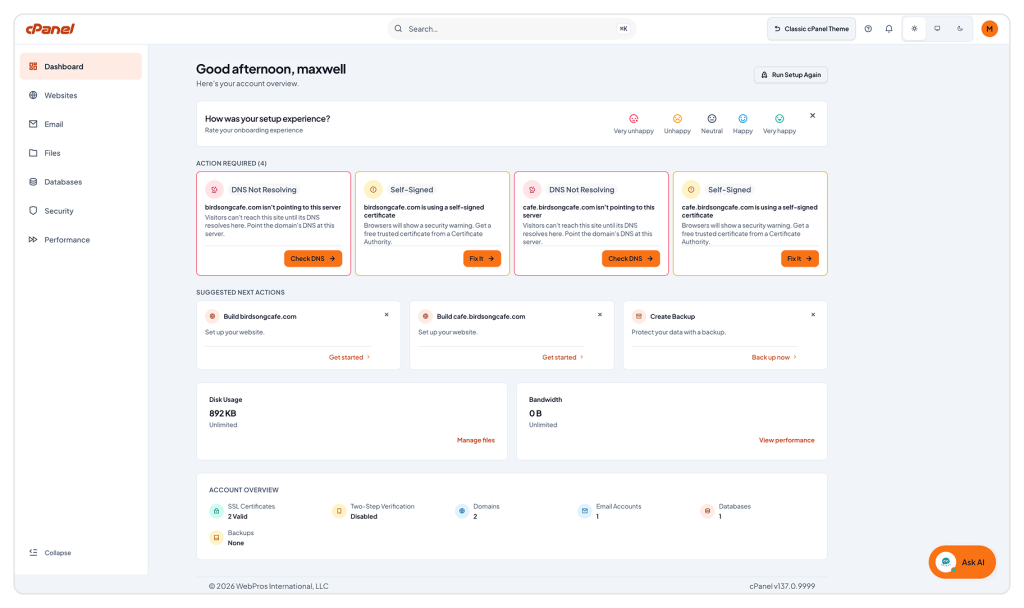
One of the biggest changes is not actually an AI model.
It is the new Meridian interface.
Meridian is a redesigned cPanel interface architecture built around the tasks users perform rather than simply presenting a large collection of individual tools.
The interface organizes hosting management into six major areas:
- Websites
- Files
- Databases
- Security
- Performance
This makes the interface more task-oriented.
Guided onboarding
Meridian also introduces guided onboarding.
A new account can go through a guided setup process designed to take the user from account creation to a live website.
The setup can include options such as:
- Sitejet Builder
- WordPress
- Node.js applications
- Git repositories
- ZIP uploads
- AI-powered website creation
cPanel says the guided experience is designed to get a new account to a live website in under ten minutes.
Meridian also provides:
- Personalized dashboards
- Quick access to frequently used tools
- Global command palette
- Light mode
- Dark mode
And importantly, Meridian is currently an opt-in environment that runs alongside the existing cPanel interface rather than forcing an immediate migration.
2. cPanel AI Assistant
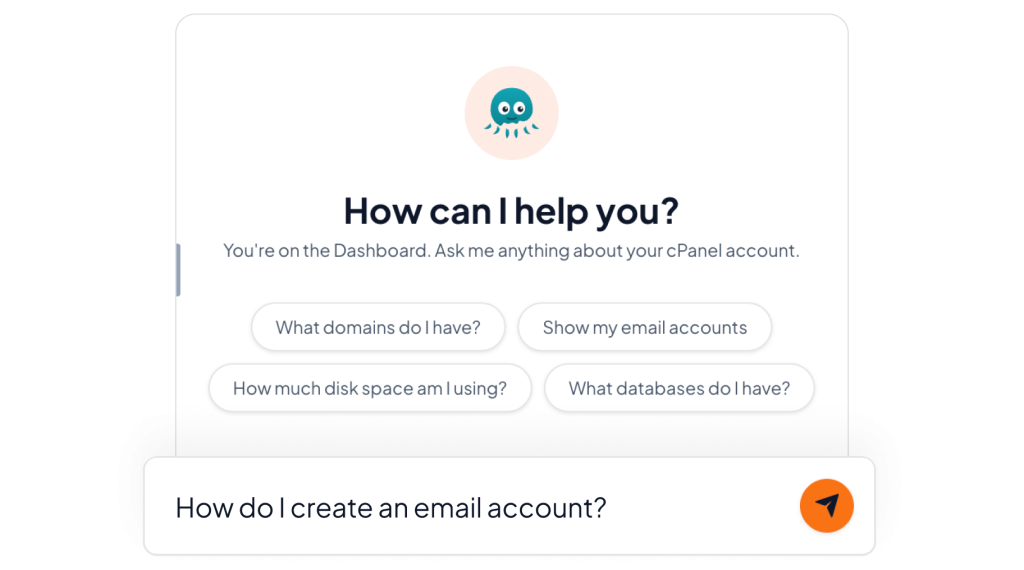
The feature most people will immediately recognize is the Integrated AI Assistant.
Instead of searching documentation or opening a support ticket, users can ask questions directly inside cPanel.
For example:
"Why isn't my website loading?"
or:
"How do I create an email account?"
or:
"Why is my DNS configuration not working?"
The AI Assistant provides contextual guidance directly inside the interface.
According to cPanel, its responses are grounded in cPanel documentation and product knowledge, while it can also analyze available account telemetry when troubleshooting problems.
That can include issues involving:
- Email delivery
- DNS configuration
- Account settings
- Other hosting configuration problems
The idea is simple:
Instead of asking users to understand cPanel first, let them explain what they are trying to accomplish.
3. AI App Hosting
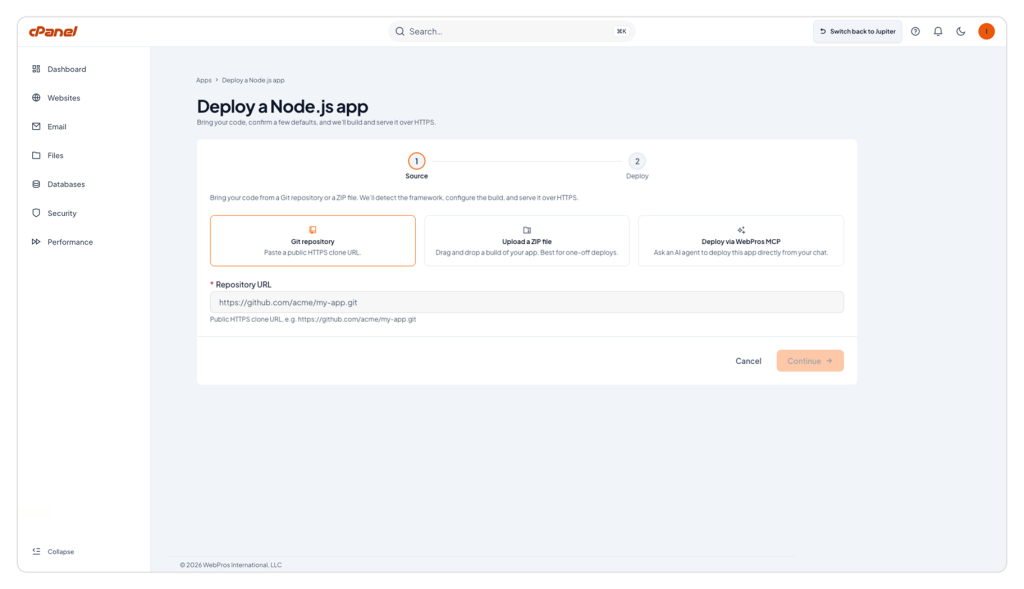
This is one of the features I find particularly interesting.
AI App Hosting is designed for applications that were created outside cPanel using modern AI development tools.
For example, a developer might use:
- Claude
- Lovable
- Bolt
- v0
- Replit
to generate an application.
The problem comes next.
How do you actually deploy that application to production?
cPanel's AI App Hosting is designed to provide that bridge.
The deployment process can involve:
- Uploading a ZIP archive
- Connecting a Git repository
- Triggering deployment through the MCP Server
- cPanel provisioning the runtime
- Applying deployment defaults
- Publishing the application to a live URL
The important part is that the hosting provider doesn't necessarily need to build a completely separate infrastructure stack for every AI coding platform.
The AI-generated application can run on the same hosting infrastructure the provider already operates.
4. MCP Server: Connecting AI to Hosting Infrastructure
This may ultimately become one of the most important parts of cPanel AI.
MCP stands for Model Context Protocol.
The MCP Server provides a controlled connection between AI agents and cPanel infrastructure.
Instead of giving an AI unrestricted server access, cPanel describes the MCP approach as a scoped and permission-controlled connection layer.
Through the MCP integration, an AI agent can potentially:
- Query infrastructure state
- Retrieve server information
- Monitor service status
- Execute approved actions
- Work with one or more cPanel servers
The important word here is controlled.
cPanel describes the architecture around:
- Permission boundaries
- Least-privilege access
- Audit logging
- Administrative control
This means administrators can maintain visibility into what AI agents can access and what actions they perform.
This is much more interesting than simply placing ChatGPT-style chat inside a control panel.
It potentially gives AI agents a structured way to interact with actual hosting infrastructure.
5. Nova: AI Website and Application Builder
Now we get to one of the biggest parts of cPanel AI.
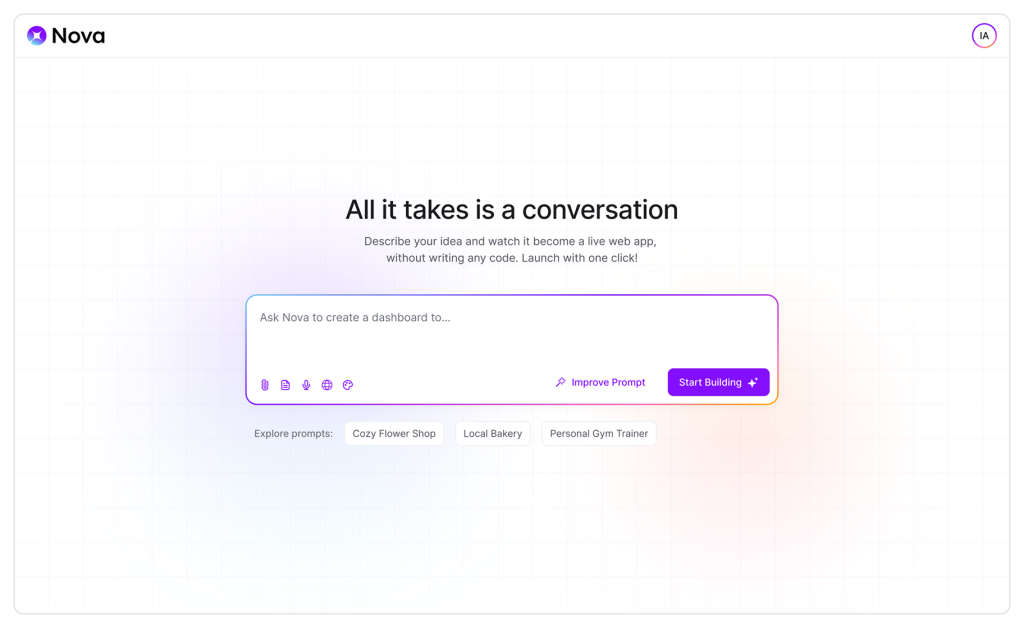
Nova is an agentic website and application builder.
The basic idea is:
Describe what you want → Nova builds it → Nova provisions hosting → Nova deploys it.
A user can describe a project using natural language.
Nova generates the codebase, provisions the hosting account and deploys the resulting project directly to the cPanel server.
That changes the traditional hosting workflow considerably.
Instead of:
Idea → Developer → Code → Server → Deployment
the workflow becomes:
Idea → AI → Hosted application
Nova is designed to appear at multiple points where a new project begins, including onboarding, website creation and application deployment.
Who is Nova for?
Potential users include:
- Small businesses
- Entrepreneurs
- Developers
- Agencies
- Freelancers
- Hosting customers
- People who don't know how to code
There is an important limitation, though.
As of the current cPanel announcement, Nova is available only to cPanel Partners.
6. Nova for WordPress

For WordPress users, this may be one of the most interesting developments.
cPanel has introduced Nova for WordPress, an AI-assisted website generator specifically designed around WordPress.
The workflow is straightforward.
A user describes the website they want.
For example:
"Create a modern website for a digital marketing agency with Home, About, Services, Case Studies, Blog and Contact pages."
Nova for WordPress can generate a complete WordPress instance and deploy it directly to the cPanel server.
But there is an important difference from many proprietary AI website builders.
The resulting website is built around standard WordPress.
That means the website remains within an ecosystem hosting providers and WordPress professionals already understand.
A provider's support team can continue working with the website using familiar WordPress workflows.
This is important because AI-generated websites don't become useful to hosting companies if every generated website requires an entirely different proprietary platform.
Nova for WordPress instead aims to shorten the time required to launch a WordPress website while keeping the familiar WordPress environment.
As with Nova, Nova for WordPress is currently available only to cPanel Partners.
7. Sitejet AI
cPanel is also bringing AI into its Sitejet ecosystem.
Sitejet AI is focused on quickly generating a production-ready first draft of a website.
The workflow is:
Describe the business → AI generates the site → Open in Sitejet Builder → Customize → Publish
For example, a business owner could describe:
"I run a local accounting firm specializing in small businesses and startups."
Sitejet AI can use that description to generate an initial website that can then be refined inside Sitejet Builder.
This makes Sitejet AI particularly interesting for users who want a fast starting point rather than a completely hands-off AI website.
The AI creates the draft.
The user still controls the final design and content.
8. AI-Native Node.js Hosting
Another important part of the announcement is the AI-native Node.js Toolkit.
This matters because AI-generated applications increasingly use modern JavaScript frameworks and Node.js rather than traditional PHP stacks.
cPanel's current release documentation describes a toolkit that can deploy AI-built Node.js applications using Podman.
This is separate from simply uploading a Node.js project through Guided Setup.
The bigger picture is that cPanel is adapting its hosting stack for applications generated by modern AI development tools.
That is significant for hosting companies because AI coding is likely to increase the number of customers deploying:
- Node.js applications
- React applications
- AI-powered web applications
- APIs
- SaaS projects
- Internal business tools
- AI agents
9. WordPress Still Matters
It would be easy to look at all these AI features and assume cPanel is moving away from WordPress.
I don't think that's what is happening.
In fact, WordPress appears to be one of the areas where cPanel sees significant AI opportunity.
cPanel already has a large WordPress ecosystem, including WP Toolkit and other WordPress management capabilities.
Nova for WordPress essentially adds another layer:
Traditional WordPress hosting
becomes
AI-assisted WordPress creation + traditional WordPress hosting and management.
That is a compelling combination for shared hosting providers.
A customer could potentially go from:
"I need a website"
to:
AI-generated WordPress site
to:
Hosted WordPress website
without needing to understand the technical steps in between.
10. What Does This Mean for Hosting Providers?
This is where cPanel AI becomes particularly interesting.
Hosting providers deal with enormous amounts of repetitive support work.
Typical tickets include:
- Website not loading
- Email not working
- DNS problems
- SSL problems
- WordPress issues
- Application deployment
- Resource usage
- Configuration questions
- Domain setup
- Database problems
cPanel's 2026 Web Hosting Trends research found that email problems, CMS/application issues, performance problems and security incidents are among the biggest sources of support workload.
AI can potentially reduce that burden.
Instead of:
Customer → Support ticket → Technician → Investigation → Resolution
the workflow can increasingly become:
Customer → AI Assistant → Contextual diagnosis → Guided resolution
And for more advanced environments:
AI Agent → MCP → cPanel infrastructure → Approved action
That could significantly change the economics of hosting support.
11. AI Could Change Shared Hosting
Shared hosting has traditionally competed on:
- Price
- Storage
- Bandwidth
- Number of websites
- Email accounts
- Control panel features
- Support
AI introduces another possible differentiator:
How much work can the hosting platform do for the customer?
Imagine two hosting providers.
Provider A
Offers:
- 50 GB storage
- 100 email accounts
- cPanel
- Manual support
Provider B
Offers:
- 50 GB storage
- 100 email accounts
- cPanel
- AI website creation
- AI WordPress creation
- AI troubleshooting
- AI application deployment
The second provider can potentially sell an outcome rather than simply selling server resources.
That's a major shift.
12. AI Doesn't Mean Giving Up Server Control
One of the biggest concerns with AI-powered infrastructure is security.
You don't want an AI agent with unrestricted root access to a production server.
A poorly configured AI system could potentially:
- Modify DNS
- Delete files
- Change configurations
- Restart services
- Alter applications
- Create accounts
- Expose sensitive information
That's why the MCP architecture is important.
cPanel describes its AI-to-infrastructure approach around scoped access, permission boundaries, least privilege and audit logging.
The ideal model is:
AI recommends → administrator/user approves → system executes → action is logged
rather than:
AI has unrestricted control
This distinction will become increasingly important as AI agents move from answering questions to actually performing infrastructure operations.
13. cPanel Is Moving From Control Panel to Operations Platform
This may be the biggest takeaway from the entire announcement.
Traditional cPanel:
Manage hosting.
Modern cPanel:
Create + deploy + manage + troubleshoot + automate hosting.
And cPanel AI pushes it further:
Describe → Build → Deploy → Manage → Diagnose → Improve
That is a fundamentally different product philosophy.
The control panel becomes less like a collection of buttons and more like an operating layer between the user, applications and infrastructure.
What the New cPanel AI Ecosystem Looks Like
The easiest way to understand all these features is to divide them into layers.
| Feature | Main purpose |
|---|---|
| Meridian | New task-oriented cPanel interface |
| AI Assistant | Natural-language support and troubleshooting |
| Nova | AI website and application creation |
| Nova for WordPress | AI-powered WordPress site creation |
| Sitejet AI | AI-assisted website generation |
| AI App Hosting | Deploy AI-generated applications |
| AI-native Node.js Toolkit | Host AI-built Node.js applications |
| MCP Server | Secure AI-to-cPanel infrastructure connection |
Together, these features form something much larger than an AI chatbot.
What This Could Mean for Developers
Developers are increasingly using AI to generate code.
The problem is that generating code is only part of the job.
You still need:
- Hosting
- DNS
- SSL
- Runtime configuration
- Deployment
- Monitoring
- Databases
- Backups
- Security
- Scaling
cPanel AI is attempting to reduce the gap between AI-generated code and production hosting.
That could be particularly useful for solo developers and small teams.
Instead of spending hours configuring infrastructure for every prototype, developers can potentially spend more time building the actual product.
What This Could Mean for Agencies
Agencies could benefit even more.
Imagine an agency receiving a new client.
Traditional workflow:
Client brief → design → development → hosting setup → deployment → revisions
AI-assisted workflow:
Client brief → AI-generated first version → hosting → deployment → human refinement
An agency could potentially produce initial website versions much faster.
Nova for WordPress is especially interesting here because the generated site remains based on WordPress rather than becoming locked into an entirely unfamiliar website platform.
What This Could Mean for Beginners
For beginners, the biggest change may be psychological.
They don't need to start by understanding:
- DNS zones
- FTP
- PHP versions
- Apache
- Node.js
- databases
- SSL configuration
They can start with:
"I want a website for my business."
AI can then guide them through the process.
The technical infrastructure doesn't disappear.
It simply becomes less visible.
And that's probably exactly what a hosting control panel should be doing.
Is cPanel AI Going to Replace System Administrators?
Probably not.
AI can automate repetitive work, but production infrastructure still requires experienced people.
System administrators will remain important for:
- Architecture
- Security
- Disaster recovery
- Performance engineering
- Networking
- Capacity planning
- Incident response
- Complex application debugging
- Compliance
- Infrastructure strategy
The difference is that AI may become another tool in the administrator's toolbox.
Instead of replacing administrators, it could make them considerably more productive.
The Biggest Question: How Reliable Will It Be?
This is the part worth watching.
Generating a website is relatively easy.
Running production infrastructure safely is much harder.
The real test for cPanel AI will be whether it can reliably handle real-world situations such as:
- A WordPress plugin breaking PHP
- DNS records pointing to the wrong server
- SSL renewal failures
- High CPU usage
- Database connection problems
- Node.js application crashes
- Email deliverability issues
- Malware infections
- Resource exhaustion
- Incorrect application deployments
If AI can reliably diagnose these issues while respecting permission boundaries, it could become extremely valuable.
My Take
I think the most important part of cPanel's AI strategy isn't Nova.
It isn't the AI Assistant either.
It isn't even the new Meridian interface.
The bigger story is the combination of all of them.
Meridian changes how users interact with cPanel.
AI Assistant changes how users get help.
Nova changes how websites and applications are created.
Nova for WordPress brings AI directly into one of the largest CMS ecosystems.
Sitejet AI accelerates website creation.
AI App Hosting connects AI-generated applications with production hosting.
MCP creates a structured bridge between AI agents and infrastructure.
Together, they move cPanel toward something much more ambitious:
An intelligent hosting platform rather than simply a hosting control panel.
And that is the part I think hosting providers should be paying attention to.
Final Thoughts
The traditional hosting model was built around a simple assumption:
Developers build websites, and hosting providers provide the infrastructure.
AI is starting to blur that boundary.
AI can now generate websites.
AI can generate applications.
AI can write deployment configurations.
AI can troubleshoot systems.
AI agents can interact with infrastructure.
And cPanel is now building those capabilities directly into the hosting environment.
The result could be a future where a customer doesn't think about servers, deployment pipelines or control-panel settings at all.
They simply describe what they want.
The hosting platform handles the rest.
We're not fully there yet.
But with Meridian, AI Assistant, Nova, Nova for WordPress, Sitejet AI, AI App Hosting and MCP, cPanel is clearly moving in that direction.
The next generation of hosting may not be defined by how many features a control panel has.
It may be defined by how intelligently the platform can use those features on behalf of the customer.
And that could be one of the biggest changes in web hosting we've seen in years.